

Short answer: You can transit through Dubai with debt or an old UAE case, but it is not risk-free. If a case is registered in your name, you can be flagged even without entering the country, and a delayed flight or overnight stopover can put you through immigration. The safest step is to have your status checked before you fly.
Many former UAE residents now living in the USA, the UK or Canada still fly through Dubai or Abu Dhabi on their way to South Asia, the Philippines or the wider Middle East. If you left an unpaid loan, credit card, bounced cheque or employment dispute behind, that routine layover can carry a risk you may not know about. This guide explains when transit is genuinely risky, which old cases matter, and how to confirm where you stand before you book.
Why This Matters If You Fly From the USA, UK or Canada Via Dubai?
Dubai is one of the busiest transit hubs for outbound travel. Emirates flies to Dubai from US airports including New York JFK, Newark, Chicago, Houston, Los Angeles, San Francisco and Washington, and from UK airports including London Heathrow, Manchester, Birmingham and Glasgow, with onward flights to Indian cities such as Mumbai, Delhi, Hyderabad and Kochi. The airline also serves Toronto, while Etihad links Abu Dhabi with cities including Toronto, London, New York and Mumbai.
For most passengers, the layover is a non-event. For anyone planning to transit through Dubai with debt still open in the UAE, it is the one point in the journey where their name meets the UAE’s systems. The US State Department’s human rights report on the UAE records that authorities have sometimes arrested people with outstanding debts or legal cases as they passed through an international airport. Philip Parham, a former UK ambassador to the UAE, gave British nationals a similar warning: unpaid debts could see them stopped and arrested if they returned, or even while in transit.
The law on cheques has changed since some of these warnings were issued. The practical risk at the airport has not.
Does a Transit Passenger Go Through UAE Immigration?
On a short connection, usually not. The risk comes from the situations that turn a transit into an entry, and those happen more often than most travelers expect.
Short Airside Connections
If you remain airside on a layover of roughly eight hours or less, a visa is typically not required. On a standard layover, your bags are checked through to your final destination and you stay in transit. This is the lowest-risk version of passing through the UAE, but it is not zero risk, because your passenger details still reach UAE authorities before you land.
Long Layovers, Transit Hotels and Stopovers
A Dubai layover with a case still open becomes far riskier once you leave the terminal. A stopover of 24 hours or more is a planned break in the journey: you collect your bags and are treated as a temporary visitor to the city. Leaving the airport during a layover generally means taking a 48 hour or 96 hour transit visa. Either way, you pass through an immigration counter.
One trap catches people who never planned to enter the UAE at all. Passengers on a single Emirates booking with a long connection may be eligible for a free transit hotel through Dubai Connect, with Emirates covering the hotel, meals, transfers and even the visa. It sounds like a perk. For someone with an open case, accepting it means walking through immigration.
When a Delay or Missed Connection Changes Everything
This is the scenario most former residents never plan for. The National has pointed out that transit passengers normally skip immigration altogether, yet a delayed flight can see them let out of the airport or put through processing, which is the point where a debt-related arrest can occur. A missed connection, an overnight rebooking or an airline hotel voucher all push you toward the same counter.
At the time of writing, the US State Department also reports significant disruption to commercial flights in the region, which makes unplanned stopovers more likely. Check the latest US State Department or UK FCDO advice before booking any route through the Gulf.
How Transit Passengers Get Flagged Before They Land?
You do not have to reach an immigration desk for your name to be checked. Airlines send passenger data to UAE authorities in advance, and officers can review that information before arrival. A debt case registered against you is meant to show up on the UAE immigration system.
A new passport does not reset this. The Philippine Consul-General in Dubai warned that renewing your passport does not take your name out of the system, since your name, date and place of birth, face and fingerprints stay the same. As he put it, “Your name is already in the system.”
Which Old UAE Cases Put You at Risk in Transit?
Even small debts can matter. Among the Filipinos detained in transit over a five-month period, most owed amounts of around AED 10,000. This table is a general guide to how different matters tend to affect a traveler passing through the UAE.
| Type of case | Typical transit risk | Why it matters |
| Unpaid loan or credit card | High | Banks often hold a security cheque and can open an execution case if it bounces |
| Bounced cheque case opened before 2022 | High until confirmed closed | It was opened when bounced cheques were still treated as a crime |
| Civil judgment or execution case | Medium to high | Execution cases can carry a travel ban until the amount is paid |
| Absconding report or labour ban | Lower in transit | Mainly blocks new work permits and re-entry |
| Criminal complaint or arrest warrant | Highest | This is exactly what airport systems are set up to flag |
Unpaid Loans and Credit Cards
Under standard UAE bank terms, three missed monthly payments in a row, or six missed payments in total, can count as a default, after which the bank may present your security cheque and open an execution case if it bounces. In an execution case, the judge can also impose a travel ban that stays until the full amount is paid. Leaving the country does not stop the process: a court can still act after the debtor has gone, and the resulting record carries a risk of detention on re-entry.
Bounced Cheque Cases From Before 2022
Since 2 January 2022, a cheque that bounces purely for lack of funds is no longer a criminal offense in the UAE, though bad-faith acts such as stopping payment without good reason or closing the account before the cheque is presented can still be prosecuted. The change came through Federal Decree-Law No. 14 of 2020 and was carried into Federal Decree-Law No. 50 of 2022, which replaced the Commercial Transactions Law.
If you left the UAE before 2022, a cheque case may have been opened under the old rules, when a bounced cheque could be treated as a crime. Whether that case was closed afterward depends on how far it had progressed and what the outcome was. An older cheque case should be checked, not assumed closed.
Civil Judgments and Execution Cases
A civil case can continue without you. Once a creditor opens an execution case, a travel ban can follow and remain until the debt is settled. It does not lapse because you moved to another country.
Absconding Reports and Labour Bans
Under Article 28(1) of Cabinet Resolution No. 1 of 2022, an employer can file an absconding report after seven consecutive days of unexplained absence. If the report is upheld, Article 50 of Federal Decree-Law No. 33 of 2021 blocks a new work permit anywhere in the UAE for one year. A labour ban is recorded by MOHRE and is separate from an immigration ban, which is the kind that can stop you entering or living in the UAE.
On its own, a labour ban does not stop you passing through. A confirmed absconding case can, however, lead to restrictions on re-entering the UAE and possibly other GCC countries, which matters if a delay forces you through immigration.
Criminal Complaints and Arrest Warrants
This is the highest-risk category. The US State Department warns that breaking UAE rules on financial crimes can lead to arrest, an exit ban, or both. An active warrant is the kind of record airport systems are designed to catch, and it is the situation where transiting without checking first makes the least sense.
The Security Cheque Most People Forget They Signed
Many former residents are surprised to learn a cheque exists at all. A Dubai-based legal adviser told Gulf News that customers usually hand over a cheque as a guarantee when they first take out a loan or credit card, and the bank later presents it to recover what is owed. These security cheques are typically undated or post-dated and held as collateral, only banked if the borrower defaults.
Consular staff handling transit detentions found that many of those held had no idea a case was pending. If you took a loan or card in the UAE and stopped paying before you left, assume a security cheque may exist until you confirm otherwise.
Is Abu Dhabi or Another Gulf Airport Any Safer?
Switching airports inside the UAE does not help, and another Gulf hub is not a guaranteed fix.
Abu Dhabi and Sharjah Use the Same UAE System
If you plan to transit Abu Dhabi with debt, the risk is the same as in Dubai. A registered case is flagged on the UAE immigration system, and Abu Dhabi and Sharjah airports sit inside the same country and the same federal immigration framework.
Doha, Muscat and Other GCC Hubs
Other Gulf airports are outside the UAE’s own system, but they are not automatically safe. The Philippine Consul-General warned that travelers can be flagged when flying with any airline that routes through the UAE or another GCC country. Gulf states do share some information, though reports suggest it is not applied consistently, which makes the outcome hard to predict.
Routes That Avoid the Gulf Entirely
If you have any doubt about an old case, connecting through a hub outside the Gulf keeps you away from UAE and GCC immigration systems altogether. It is often the simplest way to travel while you resolve the underlying matter.
Does an Old Case Expire If You Have Been Away for Years?
No. Time away does not close a case on its own. Gulf News reported former residents being detained in Dubai transit over loans and credit card debts going back as far as 10 years. Debt in the UAE rarely goes away without either a court ruling or a settlement.
What matters is whether the case was formally closed and the record updated, not how long ago you left. If you are unsure, the only reliable answer comes from a check.
What Happens If You Are Stopped in Transit
If you are flagged, you may be detained while the case is reviewed. What follows depends on the type of case, the amount and whether the creditor will settle quickly. According to the US State Department, some travelers have been able to settle debts directly at the airport, and debtors can also challenge travel bans in court. Neither is something to count on with a connecting flight waiting.
Contacting Your Embassy
US citizens can reach the US Embassy in the UAE for emergencies on +971-2-414-2200 when calling from outside the UAE. British nationals should contact the British Embassy in Abu Dhabi or the FCDO. Consular staff can offer support, but they are not a party to your case.
Why the Case Still Has to Be Resolved in the UAE
An embassy cannot close a UAE case for you. The case ends when the creditor is paid or agrees terms and the record is updated. The US State Department notes that family, friends or others have sometimes paid a debtor’s debt so they could leave the country. Having a UAE lawyer involved early is what turns that into a controlled process rather than an emergency.
How to Check Your Status Before You Fly From the USA, UK or Canada?
From abroad, the government route is usually closed to you. The official UAE services for these checks require a secure UAE Pass sign-in, and the US State Department describes exit-ban verification as something UAE residents can do with UAE authorities. For expats, Emirates ID validity is tied to the residence visa, so if your visa was canceled when you left, you are unlikely to have the active ID those systems expect.
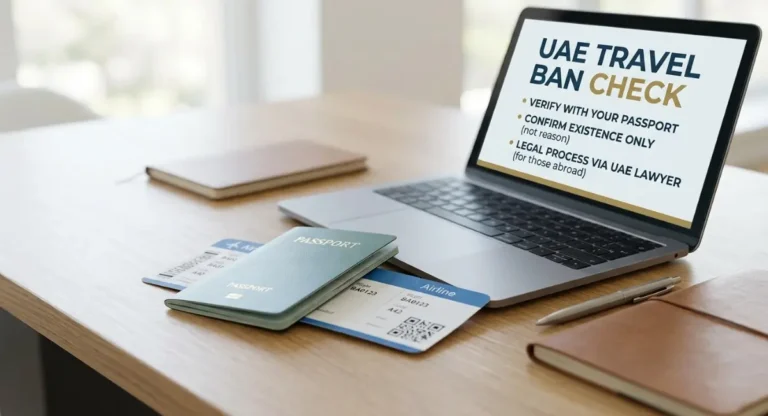
BS Lawyers carries out the travel ban check for you with the relevant authorities, using your passport number, and confirms whether a ban exists against your name. To start, you will usually need:
- A copy of your passport
- Your previous UAE visa number and Emirates ID number, if you had them
- An older passport, if your UAE visa was stamped in it
- A copy of your last UAE exit stamp
You can send everything by WhatsApp or email from the USA, the UK, Canada or anywhere else. Check your UAE travel ban status from abroad before you book your next flight through the Gulf.
If a Case Is Found, Clear It Before You Travel
Book nothing until the matter is closed and the record reflects it. Where the matter is one that can be resolved, BS Lawyers takes the legal steps needed to have the ban lifted. The general sequence looks like this:
- Agree a settlement with the creditor and get the amount and terms in writing before paying anything.
- Pay as agreed, then get a release or clearance letter confirming the debt is closed.
- Make sure the clearance is registered so your record is cleared from the relevant systems; a representative can do this if you are outside the UAE.
- Wait for written confirmation that any warrant or case has been withdrawn before you travel.
Skipping the last step can leave you exposed at the airport even after you have paid.
If you are on the other side of a debt and someone in the UAE owes you money, our guide on recovering a debt in Dubai from the USA or UK explains the evidence, steps and timelines.
Frequently Asked Questions:
Can I transit through Dubai with a travel ban?
You can try, but it is not safe. A travel ban is tied to a case registered in the UAE, and US authorities have documented arrests of people with outstanding debts or legal cases during airport transit. If you know or suspect a ban exists, have it checked and resolved before booking a route through the UAE.
Can I transit through Dubai with debt from an unpaid credit card?
Only if no case has been filed. Missed payments alone do not create a travel record; travel is affected once the bank files a legal case. Because banks commonly hold a security cheque, an unpaid card often does lead to a case, so check before you fly.
Will I be arrested if I never leave the transit area?
The risk is lower airside, but not zero. A delay can mean leaving the airport or being processed, and that is where an arrest can happen. Your details also reach UAE authorities before you land.
Does a new passport stop me from being flagged?
No. Your name, date of birth, face and fingerprints stay the same when you renew, and records are matched on identity rather than passport number alone.
Is it safer to transit through Abu Dhabi instead of Dubai?
No. Abu Dhabi and Sharjah are part of the same country and immigration system, so an open UAE case carries the same risk at every UAE airport.
My bounced cheque case is from before 2022. Am I still at risk?
Possibly. The 2022 reform removed criminal liability for cheques that bounce only for insufficient funds, but not for bad-faith conduct. A case opened before the change may or may not have been closed, so it needs to be checked.
Can I get checked if I no longer have an Emirates ID?
Yes. BS Lawyers can run the check using your passport number. Your old visa number or Emirates ID number, if you have them, make the result more complete.
How long before my flight should I get checked?
As early as possible, ideally before you book. If a case is found, settling it and having the record updated both take time, and neither should be rushed against a departure date.
This article is general information about UAE travel bans and transit risk. It is not legal advice for your specific situation. For advice on your own case, speak to a licensed UAE lawyer.