

Can a UAE bank sue you in the UK or the USA? Yes, but it has no special powers there. It has to use the same legal system as any other creditor: a fresh claim on your loan or credit card agreement, or a judgment already won in the UAE that it then asks the UK or US system to enforce. Neither route is quick or cheap for the bank, which is why most former residents hear from a collection agency long before they see a legal claim.
What a claim abroad does not touch is the file the bank may already have against you in the UAE. That file, and any travel ban linked to it, stays in place until the debt is settled and the case is closed, wherever you live now.
This guide explains how each route works in the UK and the USA, the time limits that apply, what collectors are and are not allowed to do, and how to deal with the debt without travelling to Dubai.
UAE Bank Debt in the UK and USA at a Glance
| UK (England and Wales) | USA | |
| Can a UAE bank sue you? | Yes, on the original agreement or on a UAE judgment | Yes, on the original agreement or on a UAE judgment, under the law of your state |
| Treaty shortcut for UAE judgments | None. The UAE is not part of the 2019 Hague Judgments Convention | None. The USA has signed the 2019 Convention but not ratified it |
| Time limit for the claim | Often the UAE’s time limits, because a UAE agreement is normally governed by UAE law | Usually three to six years, depending on the state |
| First formal step to watch for | A Letter of Claim with a Reply Form and 30 days to respond | A validation notice from the collector and 30 days to dispute the debt |
| Rules on collectors | Harassing a debtor is an offence under the Administration of Justice Act 1970 | Collectors must follow the Fair Debt Collection Practices Act |
How UAE Banks Pursue Debt After You Leave the UAE
Leaving the UAE with debt does not end the bank’s options. It changes where the bank has to act. Three things can happen, and they can run at the same time.
A Case in the UAE
The bank’s strongest tools are at home. It can open a civil claim for the balance or, where it holds the security cheque you signed when the loan or card was opened, enforce that cheque directly. Since the cheque reforms that took effect in 2022, a cheque returned for insufficient funds is handled mainly as a civil matter, but the cheque still works as an enforcement document. Leaving the country does not stop a case from going ahead in your absence, and a judgment or execution file in the UAE can lead to a travel ban on your file.
Collection Agencies Where You Now Live
UAE banks commonly pass the accounts of former residents to collection agencies in the borrower’s new country. These agencies phone, email and write, and some try to reach relatives or employers. A collector has no more legal power than the bank it works for. It cannot freeze your account or take your property without a judgment from the legal system where you live.
A Legal Claim Abroad
Suing in a foreign system takes the bank time and money, so a claim is more likely where the balance is large, the borrower has a good income or property, or a guarantee is involved. Smaller card balances usually stay with collectors. That is a pattern, not a rule, and nobody should plan around the idea that their debt is too small to pursue.
Can a UAE Bank Sue You in the UK?
Yes. So can Dubai debt be collected in the UK? Through collectors, certainly, and through a legal claim when the bank decides it is worth it. There is no treaty between the UK and the UAE for recognising each other’s judgments, so a UAE bank has two options in England and Wales: sue on the original agreement, or bring a claim based on a UAE judgment it has already won.
Before either kind of claim, a business chasing an individual is expected to follow the Pre-Action Protocol for Debt Claims. In practice that means a Letter of Claim setting out the debt, a statement of account and a Reply Form. You have 30 days from the date at the top of the letter to reply. That letter is the moment to take advice, not the day the claim papers arrive.
How a UAE Judgment Is Enforced in England
A UAE judgment cannot simply be registered in England. The bank has to start a new claim that treats the UAE judgment as a debt you owe. Two points decide most of these cases.
- Jurisdiction by English standards. The bank has to show the UAE had jurisdiction over you, for example because you were living there when the case started or because you agreed to UAE jurisdiction in your contract.
- Narrow defenses. You cannot reargue whether you owed the money. The defences are limited to issues such as fraud, a serious breach of fairness in the UAE proceedings (for example, never being properly notified of the case), or public policy.
This route is used. In 2023, one of the UAE’s largest banks enforced a UAE judgment worth more than AED 211 million in England against a guarantor of a company’s debt. His argument that the UAE proceedings were flawed was rejected, and the bank also obtained relief over a London property and around £2.5 million in cash he had moved to his son. It was a business guarantee rather than a credit card, but the same route is open for any money judgment.
The UK has applied the 2019 Hague Judgments Convention since 1 July 2025, which makes judgments from member countries easier to enforce. The UAE is not a member, so nothing has changed for UAE judgments.
The UK Time Limit on UAE Debt Claims
Most articles quote six years, and that is the general limit for contract debts under the Limitation Act 1980. For a UAE debt, it is often the wrong number. A loan or card agreement signed in the UAE is normally governed by UAE law, and under the Foreign Limitation Periods Act 1984 a claim in England then follows the UAE’s own time limits in most cases, not the English ones.
Acknowledging the debt can also affect the clock. Under the English rules, a payment or a written acknowledgment you have signed restarts the limitation period. Get advice before you sign anything a collector sends or make a “goodwill” payment on an old account, and make any payment part of a written settlement that closes the whole debt.
What a UK Judgment Does to Your Credit File
A judgment in England goes on the Register of Judgments, Orders and Fines for six years, and banks and lenders check it when you apply for credit or a mortgage. Paid in full within one month, it can be removed. Paid later, it stays on the register for the full six years, marked as satisfied.
Can a UAE Bank Sue You in the USA?
Yes, but it has to bring the claim in a US state where it can reach you, usually where you live or hold assets, under that state’s law. As in the UK, the bank can sue on the original loan or card agreement, or ask for a UAE judgment to be recognised and enforced.
State-by-State Recognition of UAE Judgments
There is no federal law or treaty that turns a UAE judgment into a US one. Each state decides, and many have adopted the Uniform Foreign-Country Money Judgments Recognition Act. Once a state recognises the judgment, the bank can enforce it like a local one, including wage garnishment and bank levies. You can resist recognition only on limited grounds, such as not receiving notice of the UAE case in time to defend it, fraud, or the UAE having no jurisdiction over you.
The US Time Limit on UAE Debt Claims
Most states set a limit of three to six years for debt claims, and many also have rules on which limit applies to a debt that arose in another country. A payment or an acknowledgment may restart the clock, depending on state law. Once a debt is past its time limit, a collector cannot lawfully sue you over it, although the Consumer Financial Protection Bureau notes you usually have to raise that defence yourself.
UAE Debt Collectors in the UK and USA
Most people living abroad meet the bank through a collector first. Knowing what that collector can and cannot do takes a lot of the fear out of the first call.
Rules UK Debt Collectors Must Follow
Under the Administration of Justice Act 1970, it is an offence to harass someone with demands for payment of a contract debt in a way designed to cause alarm, distress or humiliation, or to falsely claim that not paying will lead to criminal proceedings. A collector acting for a UAE bank cannot send enforcement agents or take money from your account unless the bank first gets a judgment in England.
Your Protections Under US Debt Collection Law
Collectors chasing a personal debt in the USA must follow the Fair Debt Collection Practices Act, and the law makes no exception for debts owed to foreign banks. According to the Federal Trade Commission:
- Within five days of first contact, the collector must give you validation information, including the creditor’s name and the amount claimed.
- A written dispute sent within 30 days stops collection until the collector verifies the debt.
- Collectors cannot tell your family or employer about the debt. They may contact others only to find you.
- They cannot falsely threaten arrest or legal action, or pretend to be government officials.
Threats about your visa, your green card or your job should be kept in writing and shown to a US lawyer.
Why Ignoring a Letter Makes It Worse
Silence feels safe, but it hands the timetable to the bank. In the UK, missing the 30-day reply to a Letter of Claim, and then the deadline on the claim papers, can lead to a judgment without your side being heard. In the USA, failing to dispute within 30 days lets the collector treat the debt as valid, and ignoring a lawsuit can end in wage garnishment. None of it makes the UAE file go away.
The UAE Travel Ban Risk Stays Until the Debt Is Settled
A claim abroad and a travel ban in the UAE run on separate tracks. Winning, losing or paying a claim in the UK or USA does not update the UAE system by itself. Any ban stays on your file until the UAE case is closed and the ban is lifted there.
That matters the moment you plan a trip. A ban is picked up on arrival, and connecting through the UAE can carry the same risk, as our guide on transiting through Dubai with debt explains. For what happens at the airport and how a UAE debt case turns into a ban, see our guide to returning to the UAE with unpaid debt.
Check Your UAE Status Before You Reply to the Bank
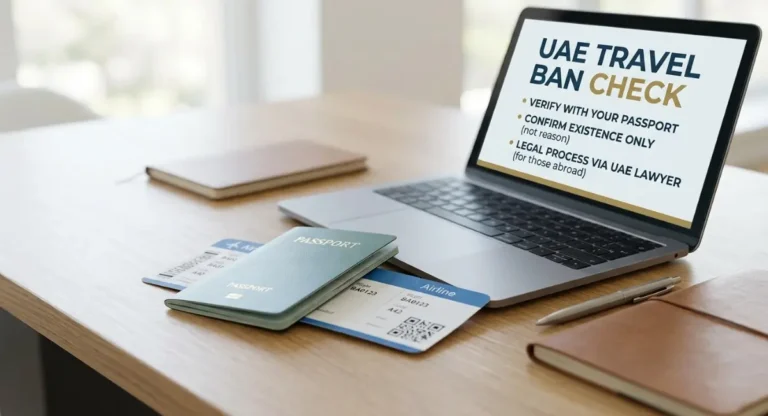
Knowing whether a travel ban is on your file tells you what is really at stake before you answer a collector or a Letter of Claim. Our travel ban check UAE service confirms your status with the relevant authorities using your passport number, with no need to travel to Dubai.
To start, we ask for:
- A copy of your current passport
- Your previous UAE visa and Emirates ID numbers, if you held them
- Any older passport that carries your UAE visa
- A copy of your last UAE exit stamp
How One Settlement Closes Both the UAE Case and the Overseas Claim
UAE banks do agree settlements and payment plans with former residents, and a lump-sum figure can be lower than the full balance. The risk is settling in pieces: paying a collector abroad while the UAE file stays open, or clearing one card while a loan with the same bank remains live. A settlement worth signing does the following:
- Covers every account with that bank, including credit cards, personal loans and car loans
- States the final figure and that it is in full and final settlement
- Binds the collector and any company that has bought the debt, not just the bank
- Commits the bank to closing any UAE case and requesting that the travel ban be lifted
- Withdraws any claim already started in the UK or USA
- Arrives on the bank’s letterhead before you pay, with payment going only to the official account named in it
Once the money is paid, ask for a clearance or no-liability letter and keep it. Then confirm the ban has actually been cleared from the system before you book a flight to or through the UAE. Our guide to removing a UAE travel ban from abroad covers that final step.
We negotiate settlements and payment plans with UAE banks for clients in the USA, the UK and Europe, and confirm the ban has been cleared before you travel. A claim already issued in the UK or USA needs a lawyer licensed there. We handle the UAE side of the same debt.
FAQs About UAE Banks Suing in the USA or UK
Can Dubai debt be collected in the UK?
Yes. A UAE bank can place the account with a UK collection agency and can bring a legal claim in England, either on the original agreement or based on a UAE judgment. A collector cannot take money or property without a UK judgment, and a claim should normally be preceded by a Letter of Claim giving you 30 days to reply.
Can a UAE bank sue me in the USA for an unpaid credit card?
Yes. The bank must bring the claim in a US state where it can reach you, usually where you live or hold assets, either on the card agreement or by asking for a UAE judgment to be recognised under that state’s law. Collectors acting for the bank must follow the Fair Debt Collection Practices Act, including sending validation details and pausing collection when you dispute the debt in time.
Is there a time limit for a UAE bank to sue me abroad?
Yes, but it is often not the one people expect. In England, a UAE loan or card agreement is normally governed by UAE law, so a claim there follows the UAE’s time limits rather than the six-year English rule. In the USA, most states set three to six years. A payment or an acknowledgment of the debt can affect the clock in both countries.
Does paying part of a UAE debt restart the time limit?
It can. Under the English rules, a payment or a signed written acknowledgment restarts the limitation period, and in many US states a partial payment may do the same. Get advice before making a goodwill payment to a collector, and make any payment part of a written settlement that closes the whole debt.
Can a UAE debt collector contact me in the USA or UK?
Yes, by phone, email or letter. In the USA, collectors must follow the Fair Debt Collection Practices Act: they cannot tell your family or employer about the debt, falsely threaten arrest or legal action, or pretend to be officials. In the UK, harassing a debtor or falsely claiming criminal consequences is an offence under the Administration of Justice Act 1970.
Can I settle a UAE bank debt without travelling to the UAE?
Yes. Settlements and payment plans with UAE banks can be negotiated and paid from abroad. Get the agreement in writing before you pay, make sure it covers every account and any collector, and ask for a clearance letter once it is paid. We handle this for clients in the USA, the UK and Europe, with no need to travel to Dubai.
Will a claim abroad lift my UAE travel ban?
No. A claim in the UK or USA and a travel ban in the UAE run separately, and paying a judgment abroad does not update the UAE system by itself. The UAE case has to be closed and the ban lifted there. Confirm the ban has been cleared before you book a flight to or through the UAE.
This guide gives general information about UAE, UK and US law and practice as of October 2026 and is not legal advice. How a foreign claim or time limit applies depends on your contract, where you live and the facts of your case, so speak to a lawyer before you respond to a bank, a collector or a legal claim. Last reviewed: October 2026.