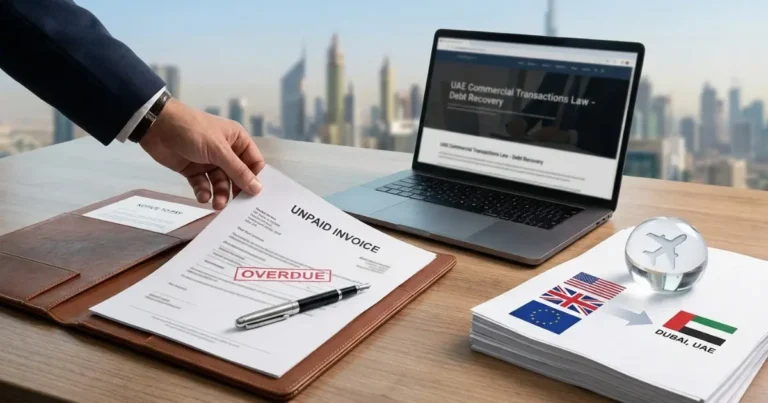

Quick answer: You can recover debt from Dubai while living in the USA or UK. A UAE lawyer reviews your evidence and the debtor’s assets, sends a formal legal notice within 2 to 3 working days, and negotiates by email. If the debtor still does not pay, a bounced cheque can go straight to execution in about 2 to 3 months, while a claim without a cheque takes about 6 to 9 months.
Key facts at a glance
| Question | Short answer |
|---|---|
| Can you start from abroad? | Yes. Case review, legal notice and negotiation happen while you stay in the USA, UK or elsewhere |
| Formal legal notice | Ready within 2 to 3 working days |
| Bounced cheque route | About 2 to 3 months to execution |
| Claim without a cheque | About 6 to 9 months |
| Travel ban threshold | Debt of AED 10,000 or more (about US$2,720), under Article 324 of the Civil Procedure Law |
| WhatsApp and email evidence | Accepted with the same weight as written documents, if authentic (Law No. 35 of 2022) |
| General time limit for civil claims | 15 years, under the Civil Transactions Law in force since 1 June 2026 |
| First consultation | Free |
Timelines are approximate and based on our experience; each case depends on the debtor’s response and assets. US dollar figures use the fixed rate of AED 3.6725 to US$1. Last reviewed: September 2026.
Can You Recover a Debt in Dubai Without Living in the UAE?
Yes. UAE law does not require you to live in the UAE to claim money you are owed, and foreign creditors can collect a debt in the UAE from abroad the same way residents can. What matters is not where you live but where the debtor and their assets are. A claim works best when the debtor lives, runs a business or holds property, bank accounts or vehicles in the UAE.
Most of the people who contact us from the USA, UK and Europe are investors or lenders. They put money into a UAE company, partnership or individual venture, received profit for two or three years, and then the payments stopped. At that point, the investment has become a debt, and it can be pursued under UAE law.
For example, if you live in Texas and wired money to a Dubai trading company that paid you a share of profit until 2025 and then went silent, your claim is tied to the UAE and can be pursued from where you are.
In short: you can recover debt from Dubai from anywhere; the debtor’s connection to the UAE is what counts.
Which Debts This Guide Covers
This guide is for debts that are connected to the UAE, such as:
- Investment or profit-share money that a UAE company, partner or individual stopped paying (see how to recover investment money in Dubai from a business partner).
- Personal loans sent by wire transfer to a friend, relative or business partner in the UAE
- Unpaid invoices and other business debts owed by a UAE company
- Bounced or security cheques issued by a debtor in the UAE
If the debt was created in the USA or UK and the debtor later moved to Dubai, the route is different, and we cover that situation in a separate guide.
What Evidence Do You Need to Recover Debt From Dubai?
You need proof that money went to the debtor and proof that it was owed back. The stronger and more direct that proof is, the faster your case moves. You do not always need a formal contract: we regularly take cases built on bank transfer receipts and written acknowledgments from the debtor.
| Evidence | Why it matters | Strength |
|---|---|---|
| Bank transfer receipts | Proves the money actually reached the debtor | Very strong for payment; pair it with proof that it was a loan or investment |
| Signed contract or loan agreement | Sets the amount, due date and jurisdiction clause | Strong |
| Cheque (payment or security) | A bounced cheque can go directly to execution | Strong |
| WhatsApp or email acknowledgments | Shows the debtor accepted they owe you | Strong, if authentic |
| Profit or repayment history | Shows an agreement existed and was being honored | Supporting |
| Debtor’s Emirates ID and passport copy | Identifies exactly who you are claiming against | Supporting |
In short: bank receipts prove the money moved; messages, contracts or cheques prove why it has to come back.
Can WhatsApp Messages and Bank Transfers Prove a Loan?
Yes, especially together. Under the UAE’s Law of Evidence (Federal Decree-Law No. 35 of 2022), Articles 53 to 55 treat electronic messages, including WhatsApp and email, as written evidence, provided their authenticity can be verified. A bank transfer on its own shows that money moved, but not whether it was a loan, a gift or payment for something. A message where the debtor asks for the money, confirms receiving it or promises to repay fills that gap.
For example, a woman in the UAE recovered close to Dh1 million after her WhatsApp conversations showed the other party acknowledging the money and promising to repay it.
Keep the phone the messages are on, do not delete chats, and export them with dates and times visible.
In short: a transfer receipt plus a message acknowledging the debt is often enough to build a case.
Do Your Documents Need to Be in Arabic?
Yes, for filing. Onshore legal proceedings in the UAE run in Arabic, so contracts, messages and other evidence need a legal Arabic translation before they are filed. You do not need to speak Arabic yourself. You deal with our team in English, and the Arabic filings are part of our work.
How Debt Recovery From Abroad Works, Step by Step
If you are wondering how to recover money from someone in Dubai while living abroad, the process follows five steps, and the first three happen while you stay at home. Here is how a typical case moves with our debt recovery lawyers in Dubai.
Step 1: Case Review and Asset Check
Your first consultation is free and takes place by phone, WhatsApp or email. We review your documents and check whether the debtor has a business, property or other assets in the UAE before recommending any action. If there is nothing realistic to recover, we tell you honestly at this stage.
Step 2: Formal Legal Notice (2 to 3 Working Days)
We prepare a formal legal notice within 2 to 3 working days. It sets out the amount owed, the basis of your claim and a deadline to pay. Many debtors respond once a UAE law firm is involved, and the notice also shows that you tried to settle before taking legal action.
Step 3: Negotiation by Email While You Stay Abroad
We negotiate with the debtor by email, so you never need to be on a call at 3 a.m. Dubai is 8 hours ahead of New York in summer and 9 hours in winter, and 3 to 4 hours ahead of London, so written negotiation works better across time zones. Any settlement is recorded in writing, with a payment schedule.
Step 4: Legal Action
If the debtor does not pay or settle, the route depends on your evidence:
- With a bounced cheque: the cheque can go directly to execution, usually within about 2 to 3 months.
- Without a cheque: we file a civil claim based on your contract, transfers and messages, which usually takes about 6 to 9 months.
UAE law also has a faster payment-order procedure for debts that are written, fixed in amount and due. Whether it fits depends on your documents.
Step 5: Enforcement and Asset Search
After a judgment, or once a cheque is accepted for execution, the case moves to the Execution Judge. If the debtor does not pay within seven days of being notified, the Execution Judge can request reports from banks, the Roads and Transport Authority, the Land Department and other relevant authorities to trace assets. Available measures include attaching bank accounts, property, vehicles and salaries.
We request a travel ban the day after judgment, and approval usually takes between 2 hours and 2 days.
In short: you stay abroad during review, notice and negotiation; the legal stages then turn your claim into enforceable pressure on the debtor.
How Long Does It Take to Get Your Money Back From Dubai?
Most recoveries take somewhere between a few weeks and about 9 months. The biggest factors are whether you hold a bounced cheque and how the debtor responds.
| Route | Typical timeline | What changes it |
|---|---|---|
| Formal legal notice | 2 to 3 working days to prepare | How fast documents reach us |
| Settlement after notice | Days to a few weeks | The debtor’s willingness to pay |
| Bounced cheque execution | About 2 to 3 months | Objections by the debtor, assets found |
| Civil claim without a cheque | About 6 to 9 months | Strength of evidence, appeals |
| Travel ban after judgment | Requested the next day; usually approved in 2 hours to 2 days | Meeting the legal conditions |
In short: a cheque roughly halves the timeline compared with a claim built on transfers and messages.
Holding a Bounced Cheque? The Faster Route
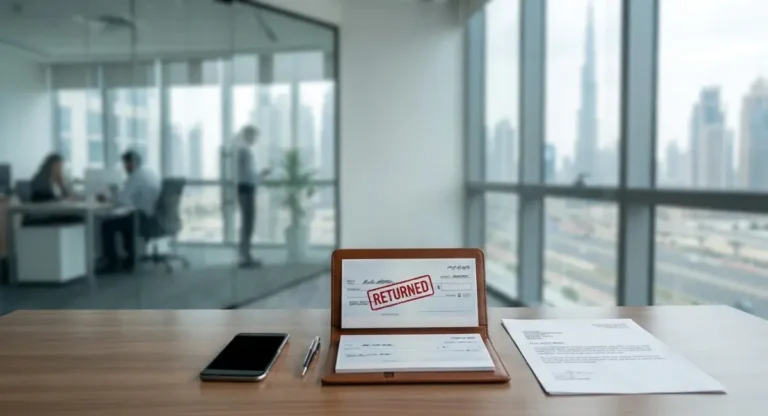
A bounced cheque is the fastest route to recovery because it counts as an executive instrument under UAE law. Under Article 667 of the Commercial Transactions Law (Federal Decree-Law No. 50 of 2022), a cheque returned for no or insufficient funds can be taken straight to execution, without first winning a separate case. Since 2022, most bounced cheques have been treated as civil matters rather than crimes, although bad-faith cases such as forgery can still carry criminal consequences.
Three details help overseas creditors:
- Closed accounts count: a cheque returned because the account was closed is treated the same as one returned for insufficient funds, following a 2023 unifying legal decision.
- Partial payment: the bank must pay whatever balance is available, and you can execute for the rest.
- Keep the original: hold on to the original cheque and the bank’s return note, because execution depends on them. You can send both to us in Dubai by courier.
Why a Security Cheque Is Different
A security cheque, given as a guarantee rather than as payment, does not always meet the conditions for direct execution, and the debtor may object that nothing was due when it was presented. In those cases, the cheque becomes strong evidence inside a civil claim rather than a shortcut around it. We check the cheque’s purpose before choosing the route.
In short: a payment cheque is a shortcut; a security cheque is powerful evidence, but it may need a claim behind it.
Can the Debtor Be Stopped From Leaving the UAE?
Yes. Under Article 324 of the Civil Procedure Law (Federal Decree-Law No. 42 of 2022, as amended), a creditor can ask the Execution Judge for a travel ban when the debt is AED 10,000 or more (about US$2,720) and there are serious reasons to fear the debtor will leave the UAE. A ban can be requested even before the main claim is filed. If the amount is not yet fixed, the request needs written evidence and a guarantee from the creditor, as this 2026 enforcement guide explains.
A ban usually stays in place until the debt is paid, settled or secured. For company debts, a manager is not automatically banned, but Article 322 allows measures against a company’s legal representative where the failure to pay is personally attributable to them.
If you are the one who owes money and want to know whether a ban exists against you, our UAE travel ban check from abroad can confirm it.
In short: a travel ban keeps the debtor within reach, and it is often the step that brings them to the table.
What If the Debtor Has Already Left the UAE?
It depends on what the debtor still has in the UAE. If they have no business, property, bank accounts or realistic plans to return, a UAE claim may not be worth pursuing, and we will tell you so. If they still own assets, run a company or are likely to come back, we can file, move to execution and request a travel ban so they cannot leave again if they return.
Pursuing a debtor in the country where they now live is a separate process that needs a lawyer in that country.
In short: a debtor leaving is not the end of the claim; leaving with nothing behind often is.
What If Your Contract Names the DIFC?
The Dubai International Financial Centre (DIFC) has its own English-language, common-law legal system inside Dubai. Parties anywhere in the world can choose it by agreeing in writing, under Article 5(A)(2) of Dubai’s Judicial Authority Law. The clause has to be clear and express. Claims have been dismissed where the contract did not clearly choose the DIFC.
Our team includes DIFC-certified lawyers and handles arbitration, so send us the full contract and we will confirm which system your claim belongs to.
In short: the jurisdiction clause decides where your claim goes, so read it before anything else.
Is There a Time Limit to Recover a Debt in the UAE in 2026?
Yes. The new Civil Transactions Law (Federal Decree-Law No. 25 of 2025) has applied since 1 June 2026 and keeps the general 15-year limit for civil claims. Some claims, such as fees for professional services, have much shorter periods. Limitation periods that had not expired by 1 June 2026 now follow the new law, so an older debt should be checked now rather than later.
In short: most debts are not time-barred, but waiting weakens evidence even when the law still allows a claim.
Do You Need a Lawyer or a Collection Agency?
For a debt owed in the UAE, you need a lawyer once a letter or phone call does not work. A collection agency can contact the debtor, but it cannot request a travel ban, execute a cheque or attach assets. Those steps only happen through legal action, before the Execution Judge.
See how our debt recovery service works for the full process. In short: agencies can ask; lawyers can enforce.
How Much Does It Cost to Recover Debt From Dubai?
The cost depends on your case and how long it takes. A debt that settles after a legal notice involves far less work than one that goes through a full claim and enforcement, so there is no single price that fits every case.
Your first consultation is free. Once we have reviewed your documents, we explain what your case is likely to involve, and we tell you honestly whether legal action makes sense for the amount you are owed.
In short: the right question is not just cost, but cost compared with what the debtor can realistically pay.
5 Mistakes That Make Recovery From Abroad Harder
- Waiting too long. Debtors move money, change numbers and leave, and every month makes assets harder to find.
- Deleting chats or changing phones. Your WhatsApp history may be your strongest evidence, so back it up before anything else.
- Naming the wrong debtor. A brand name is not a legal entity; claims must name the exact company or person who owes you.
- Suing before checking assets. A judgment against someone with nothing in the UAE is hard to collect.
- Ignoring the jurisdiction clause. A DIFC or arbitration clause changes where and how your claim must be filed.
“Act early and keep every record. Your bank transfer receipts and any WhatsApp or email where the debtor accepts the debt are often your strongest evidence, and the sooner we check the debtor’s assets, the better your chance of recovering the money.” Ms. Maleka, Senior Family & Corporate Lawyer, BS Lawyers & Legal Consultants
Key Takeaways
- You can recover money from the UAE while living in the USA, UK or Europe, as long as the debt is connected to the UAE.
- Bank transfers plus WhatsApp or email acknowledgments can prove a debt without a formal contract.
- A bounced cheque can go straight to execution in about 2 to 3 months; a claim without one takes about 6 to 9 months.
- A travel ban is available for debts of AED 10,000 (about US$2,720) or more.
- Recovery depends on the debtor having assets or ties in the UAE, which is why we check assets first.
Frequently Asked Questions
Can I recover a debt in Dubai without traveling to the UAE?
Yes. You can recover debt from Dubai without traveling for the early stages. Case review, the formal legal notice and negotiation by email all take place without you traveling. Whether any later step needs you in the UAE depends on your case, and we explain this at the start.
Can I sue someone in Dubai from the USA?
Yes. Foreign individuals and companies can bring claims in the UAE the same way residents can. The claim works best when the debtor lives, does business or holds assets in the UAE, and our team files on your behalf while you communicate with us in English.
How long does it take to get my money back from Dubai?
A formal legal notice is ready within 2 to 3 working days, and some debtors settle within weeks. If they do not, a bounced cheque usually reaches execution in about 2 to 3 months, while a claim without a cheque takes about 6 to 9 months.
What if the debtor has no assets in the UAE?
Then a UAE claim may not be worth pursuing, and we will tell you honestly. Recovery depends on the debtor having money, property, a business or ties to the UAE. If they are likely to return, a judgment and travel ban can still protect your position.
Can I use a bounced cheque if I live abroad?
Yes. Under Article 667 of the Commercial Transactions Law, a cheque returned for no or insufficient funds can go straight to execution. Keep the original cheque and the bank’s return note safe, and send them to us in Dubai by courier.
Can a US judgment be enforced in Dubai?
Possibly, but it is not automatic. Article 222 of the Civil Procedure Law allows enforcement of foreign judgments that meet strict conditions, even without a treaty, and at least one US judgment has been enforced this way. Outcomes have varied, so filing directly in the UAE is often more predictable.
Do I need to speak Arabic to recover a debt in Dubai?
No. Onshore UAE proceedings run in Arabic and documents need a legal Arabic translation, but you deal with our team in English. The Arabic filings are part of our work.
Is the first consultation free?
Yes. Your first consultation by phone, WhatsApp or email is free. After that, the cost depends on your case and how long it takes, and we explain it once we have reviewed your documents.
Disclaimer
This guide gives general information about UAE law as of September 2026 and is not legal advice. Every debt is different, so speak to a lawyer about your specific situation before taking action.