

A UAE debt travel ban is not automatic, and owing money in the UAE is not the same as having a case against you. Plenty of people leave with a balance outstanding and go back years later without incident. Others find out at the immigration counter that something was filed after they left. The difference between those two outcomes usually comes down to what happened in the months after departure, not the fact that a debt existed.
Leaving With Debt and Having a Case Against You Are Not the Same Thing
Unpaid debt on its own
Unpaid bank debt in the UAE is a civil matter. Leaving the country while a balance is outstanding does not, by itself, make it a criminal one. A Dubai lawyer made exactly this point in a recent piece on the financial mistakes expats make when leaving.
You are also not required to clear everything before you go. UAE lawyers have said the same thing to Gulf News: repayments can be made from outside the country, and leaving while still owing money is not the end of the road.
What turns it into something that stops you at the border
What changes the picture is silence.
A balance that is being paid, even slowly, even from abroad, is a relationship the bank is managing. A balance that goes quiet, with a phone number that no longer works and emails that bounce, is a file the bank hands to someone else. That is the point at which enforcement starts, and enforcement is where travel bans come from.
Almost every difficult case we see follows the same shape: the person did not refuse to pay, they simply stopped answering.
How a UAE Debt Travel Ban Actually Gets There
When a creditor can ask for one
Under the UAE Civil Procedure Law, a creditor can ask for a travel ban against a debtor where the amount passes a set threshold and there are serious grounds to think the debtor will leave. It is a step within enforcement, not a punishment handed down on its own.
Because it is tied to the claim rather than to a calendar, it does not lapse quietly. It sits there until the matter behind it is resolved and the removal is processed.
Why nobody tells you
A ban is recorded against your file. It is not posted to your last UAE address, and nobody calls the number you had three years ago.
That is why so many people discover one at an airport. Our guide on removing a UAE travel ban from abroad covers what happens after that point, but the useful move is to find out before you are standing at a counter.
The Security Cheque Nobody Thinks About
Here is where an ordinary civil debt can turn into something else.
Most UAE loans and credit facilities are backed by a security cheque signed at the start. The lawyer quoted above put it plainly: complications arise where that cheque is presented after the account has been emptied or closed before departure.
Think about how normal that sequence looks from the inside. You are leaving the country, so you close your UAE account and move the balance home. Months later the bank presents the cheque, and it comes back marked for a closed account rather than for insufficient funds. That is a different category, and it is one of the situations that stayed criminal after the 2022 reform.
The account closure is what does the damage, not the debt. Our guide on what happens with a bounced cheque in Dubai sets out which reasons sit on which side of that line.
What Happens at the Airport When You Come Back
If there is no case
Nothing. You land, you clear immigration, and the debt remains a debt. A balance sitting on a bank’s books is not something the border checks for.
If a case exists
This is where it depends on the type of file. A civil enforcement matter and a criminal one are handled differently on arrival, and the practical difference is significant for anybody planning a short trip.
If the file is an old criminal one
Gulf News reported that people whose cheque cases were passed on before the January 2022 change are likely to face detention at a port of entry while the file is dealt with, and that this can run from a few hours to a couple of days before the matter is converted.
That is a specific group: older cases, already escalated, not yet converted. But if you left the UAE before 2022 with a cheque in play, it is the scenario worth ruling out before booking anything.
Settling a UAE Debt From the USA, UK or Europe
Something changed after the reform
Gulf News reported that expats who left after business failures or job losses have been coming back to settle with banks and other creditors, because the matter became one they could negotiate rather than one they had to avoid.
That is the practical shift. Settlement from abroad is now a normal conversation rather than an unusual one.
What the bank needs from you
Banks assess what you can realistically pay, and they look at your circumstances now rather than the ones you had when the loan was taken out. A job loss or a business that failed is information that helps the conversation, not something to hide from it.
What matters most is that any arrangement is recorded in writing. The person you speak to may move on; the written agreement does not.
The clearance letter people forget to ask for
Once the balance is settled, ask the bank for an official clearance letter confirming the obligation is closed, and keep it.
People skip this step constantly because paying feels like the finish line. It is not. The letter is what you produce if anything surfaces later, and without it you are relying on a bank’s internal records to speak for you.
If You Genuinely Cannot Pay
Not every situation can be settled, and that case is not hopeless either.
The UAE has a dedicated insolvency framework for individuals who are not traders, published on the UAE legislation portal and in force since late 2019. It is a court-supervised route that allows a person in genuine financial difficulty to restructure what they owe, rather than leaving them exposed to enforcement indefinitely.
It is not a way to walk away from a debt, and it is not right for everybody. But it exists, and it is rarely mentioned in the advice people find when they search this topic in a panic.
Before You Book a Flight to the UAE
The order that saves people trouble is simple: find out, then resolve, then travel.
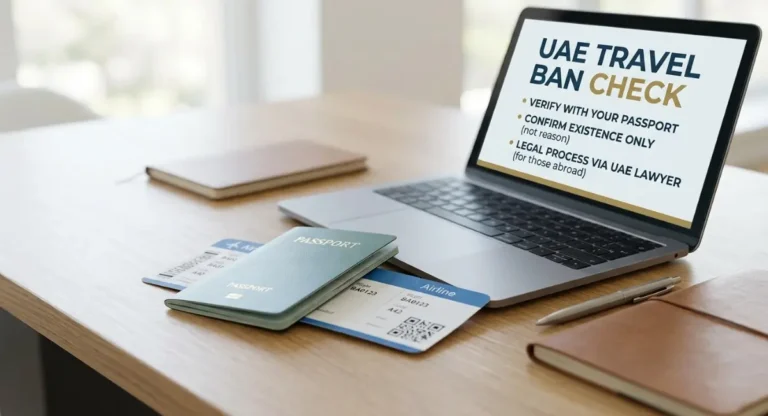
Checking is the part most people cannot do themselves. The UAE online services that show case and ban information are built around UAE Pass and an active Emirates ID, and former residents have neither. Gulf News notes that where someone cannot check through those channels, a law firm can verify the position and the reasons behind it.
That is what a travel ban check UAE involves on our side: we confirm whether anything exists using your passport number, while you stay where you are. It helps to have your passport, your previous UAE visa number, your Emirates ID number if you held one, your older passport if the UAE visa was stamped in it, and a copy of your last UAE exit stamp.
One more thing worth knowing: a connecting flight counts. Passenger data is shared before you land, so a layover is not a way around an active ban, as our guide on transiting through Dubai with an old case or debt explains.
Questions About Returning to the UAE With Debt
Can I enter the UAE if I have unpaid debt?
Usually yes, if no case has been filed and no ban is recorded. Unpaid bank debt is a civil matter in the UAE, and a balance on its own is not something checked at the border. The risk comes from what was filed after you left, which is why confirming the position first is the sensible order.
Does a UAE debt travel ban stop me entering or only leaving?
A UAE debt travel ban of this kind restricts movement in connection with the case, and it is recorded against your file rather than against a particular journey. Whether it affects a specific trip depends on the type of case, which is why the useful question is what exists on your file, not which direction you are travelling.
Can I pay a UAE loan after I have left the country?
Yes. UAE lawyers have confirmed to Gulf News that repayments can be made from outside the country and that you are not required to clear everything before leaving. The negotiation can be handled by email, and any arrangement should be put in writing.
Will my debt expire if I stay away long enough?
Not in the way people hope. Claims in the UAE have their own time limits, and they do not simply dissolve because somebody moved abroad. Waiting also tends to make the position worse rather than better, because enforcement continues while you are away.
Can I check whether a case exists before I travel?
Yes, though not usually through the government portals, which need UAE Pass and an active Emirates ID. Someone acting on your behalf in the UAE can confirm whether a travel ban or case exists using your passport number, and that check is worth doing before a flight rather than after.
Disclaimer: This guide gives general information about UAE law and procedure as of October 2026 and is not legal advice. Every case turns on its own facts, so speak to a lawyer about your own situation before making travel plans or agreeing anything with a creditor.