

Quick answer: You can enforce a bounced cheque in the UAE from abroad, and it is a faster route than an ordinary debt because the cheque itself can be taken straight to enforcement, without first winning a separate claim. You do not need to be in the UAE for this. But the window to use that route does not stay open, which is why the date on the cheque matters as much as the amount.
Key Facts at a Glance
| Question | Short answer |
| Do you need to win a case first? | No. A properly returned cheque can go straight to enforcement |
| Do you need to be in the UAE? | No. A UAE lawyer files on your behalf |
| What you must have | The original cheque and the bank’s return memo |
| How long you have | Generally two years from the end of the presentment period for the fast route; the debt itself can still be claimed after that |
| How long enforcement takes | About 2 to 3 months in a straightforward matter |
| If the account has partial funds | The bank pays what is available; you can pursue the balance |
| Travel ban on the debtor | Available for debts of AED 10,000 or more (about US$2,720) |
| First consultation | Free, by phone, WhatsApp or email |
Timelines are approximate and based on our experience. US dollar figures use the fixed rate of AED 3.6725 to US$1. Last reviewed: September 2026.
Why a Bounced UAE Cheque Is Stronger Than an Ordinary Debt
A returned cheque puts you in a better position than almost any other kind of unpaid debt in the UAE, and many overseas creditors do not realise it.
The Cheque Itself Is the Enforcement Document
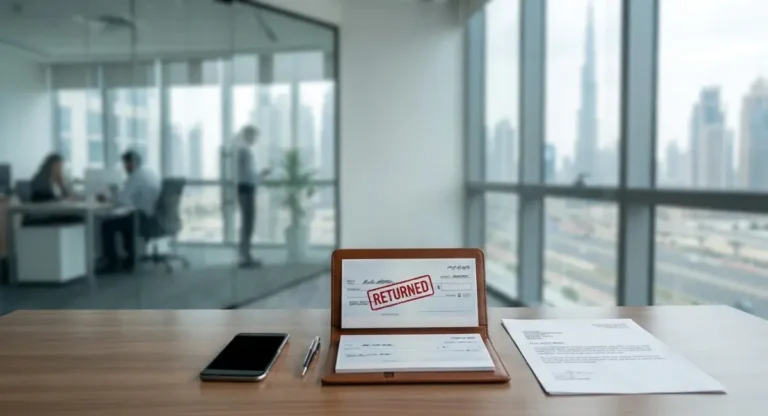
Under the Commercial Transactions Law (Federal Decree-Law No. 50 of 2022), a cheque returned for insufficient or unavailable funds becomes an enforcement instrument in its own right once the bank issues its return memo confirming the reason. This is what makes a UAE cheque a writ of execution rather than ordinary evidence of a debt.
In practice this means you skip the longest and most expensive part of a normal claim. You do not have to prove the debt existed, argue about a contract, or win a judgment first. The cheque and the bank’s memo are the proof.
For example, a creditor in London owed AED 300,000 by a Dubai company would ordinarily face a full civil claim taking many months. With a properly returned cheque for that amount, the matter can move to the enforcement stage directly.
In short: an ordinary debt has to be proved; a bounced cheque is already proof.
What the Reform Actually Changed
The decriminalisation itself took effect in January 2022. The current Commercial Transactions Law (Federal Decree-Law No. 50 of 2022), in force since 2 January 2023, replaced the 1993 law and carried that position forward.
The headline change was that a cheque bouncing purely for lack of funds is now treated as a civil matter rather than an automatic criminal one. It is easy to read that as bad news for creditors. It is not. The same reform strengthened the enforcement route, giving cheque holders a faster path to the money than they had before.
In short: the reform moved the focus from punishing the debtor to getting the creditor paid.
The Deadline Most Creditors Miss
This is the part overseas creditors most often miss, because nothing in the process warns you about it.
Two Years, Not Forever
A cheque holder generally has two years to bring the claim, running from the end of the period in which the cheque should have been presented to the bank, as Gulf News has explained. That presentment period is itself limited, commonly around six months from the date written on the cheque, though it can differ depending on whether the cheque was issued inside the UAE or abroad.
The practical effect is that the clock starts long before most people realise they have a problem. A cheque sitting in a drawer since 2023 may already be outside the window.
The Exception That Can Save a Late Claim
There is an important carve-out. That deadline does not apply where it is proven that the person who wrote the cheque never provided the funds to cover it on the due date, or provided them and then withdrew all or part of them.
That is exactly what happens in many investment and loan disputes, where a cheque was handed over as a guarantee and the account was quietly emptied afterwards.
Even when the two-year window has closed, the cheque is not worthless. What is lost is the fast route, not the debt. The claim can still be brought as an ordinary civil case with the cheque used as evidence, where the general limitation period is considerably longer. What you give up is the speed, and the immediate route to a travel ban.
In short: assume you are on the clock, but do not assume a late cheque is worthless until a lawyer has looked at it.
How Enforcement Works When You Are Not in the UAE
If you are wondering how to collect a bounced cheque in UAE while living overseas, the whole process runs while you stay where you are. There are five stages. Here is how debt recovery Dubai cases move when the creditor is overseas.
Step 1: Send Us the Cheque and the Return Memo
You will need the original cheque and the bank’s return memo stating why it was not paid. Copies are not enough for the enforcement route. You can send both to us in Dubai by courier.
Your first consultation is free and takes place by phone, WhatsApp or email.
Step 2: Asset Check and Legal Notice
Before recommending any action, we check whether the debtor has a business, property or other assets in the UAE. If there is nothing realistic to recover, we tell you at this stage rather than after you have spent money.
Where the position is workable, we prepare a formal legal notice within 2 to 3 working days.
Step 3: Negotiation by Email
Many debtors move once lawyers in Dubai are involved. We negotiate by email, so nothing depends on you being available at a particular hour. Dubai is 8 hours ahead of New York in summer and 9 in winter, and 3 to 4 hours ahead of London.
Any settlement is recorded in writing, with a payment schedule.
Step 4: Enforcement
If the debtor does not pay, the cheque goes to execution. Bounced cheque execution in the UAE usually takes about 2 to 3 months in a straightforward matter.
Once the enforcement order is served, the debtor typically has around seven days to comply.
Step 5: Enforcement Measures
If they still do not pay, the available measures include attaching bank accounts, property, vehicles and salaries. Where the conditions are met, a travel ban can also be sought against the debtor for debts of AED 10,000 or more (about US$2,720), under the Civil Procedure Law.
In short: you supply the cheque and the memo; everything after that happens in Dubai.
What If the Bank Paid Part of the Cheque?
This part is often missed, and it works in your favour.
If the debtor’s account holds some money but not the full cheque amount, the bank is required to pay out what is available rather than refusing the cheque outright. The partial payment is recorded on the cheque, and you receive the original back together with a certificate of what was paid.
Two things follow from this:
- You recover something immediately, instead of nothing.
- Your claim for the balance survives. The cheque, marked with the partial payment, is what establishes your right to the rest.
For example, a cheque for AED 500,000 presented against an account holding AED 120,000 does not simply bounce. The AED 120,000 is paid out, and the remaining AED 380,000 can still be enforced.
In short: a partly paid cheque is not a failed cheque.
When a Bounced Cheque Is Still a Criminal Matter
The reform did not remove criminal liability entirely. It narrowed it to deliberate conduct.
Criminal exposure can still arise where the person who wrote the cheque:
- instructed the bank not to pay it, without a legitimate basis
- closed the account or withdrew the funds before the cheque was presented
- issued the cheque on an account that did not exist
- signed or wrote it in a way designed to prevent payment
- forged or altered the cheque
One point matters for creditors: these are genuinely narrower than most people assume, so do not build your expectations around a criminal outcome.
In short: the money usually comes from enforcement, not from a criminal complaint.
Four Situations Overseas Creditors Run Into
The Debtor Has Already Left the UAE
It depends on what they left behind. If there is no business, property, bank account or realistic prospect of them returning, we will tell you the claim is not worth pursuing. If assets or ties remain, enforcement can still work, and a travel ban means they cannot leave again if they come back.
Our guide on recovering a debt in Dubai from the USA or UK covers this in more detail.
The Cheque Came From a Company
A company cheque is signed by someone, and who the claim runs against is not always obvious. Send us the cheque and the company details and we will tell you where the claim properly lies.
It Was a Security Cheque, Not a Payment Cheque
A cheque given as a guarantee rather than as payment does not always meet the conditions for the direct enforcement route, because the debtor may argue nothing was due when it was presented.
That does not make it worthless. It becomes strong evidence inside a claim rather than a shortcut around one. We check what the cheque was actually for before choosing the route.
Your Contract Names the DIFC
The Dubai International Financial Centre operates its own English-language, common-law system inside Dubai, and parties anywhere in the world can choose it in writing. The clause has to be clear and express.
Our team includes DIFC-certified lawyers and handles arbitration, so send us the full contract and we will confirm which system your claim belongs to.
Key Takeaways
- You can enforce a bounced cheque in the UAE from abroad. The returned cheque with the bank’s memo goes straight to enforcement, without you first winning a claim.
- You do not need to be in the UAE. The original cheque and memo can be couriered to us.
- You generally have two years from the end of the presentment period for the fast route. After that the debt can still be claimed, but not that way.
- If the account holds partial funds, the bank pays what is there and your claim for the balance survives.
- Enforcement is usually where the money comes from. Criminal liability now applies only to deliberate conduct.
Frequently Asked Questions
Can I enforce a UAE cheque if I live in the USA or UK?
Yes. You do not need to be in the UAE. You send us the original cheque and the bank’s return memo, and our team files and acts on your behalf while you stay where you are. Your first consultation is free.
Do I need to win a legal case first?
No. That is the main advantage of holding a cheque. Under the Commercial Transactions Law, a cheque returned for insufficient or unavailable funds becomes an enforcement instrument once the bank issues its return memo, so the debt does not have to be proved from scratch.
How long do I have to act on a bounced UAE cheque?
Generally two years, running from the end of the period in which the cheque should have been presented to the bank. Because that presentment period is itself limited, the clock often starts earlier than people expect. If the two-year window has passed, the fast route is lost but the debt is not; the claim can still be brought as an ordinary civil case with the cheque as evidence.
What documents do I need?
The original cheque and the bank’s return memo stating why it was not paid. Copies are not sufficient for the enforcement route. Any contract, invoices or messages relating to the underlying debt help, but the cheque and memo are the core.
How long does enforcement take?
In a straightforward matter, about 2 to 3 months. Once the enforcement order is served, the debtor typically has around seven days to comply before further measures follow. Objections by the debtor and the assets available can extend this.
What if the bank only paid part of the cheque?
That works in your favour. The bank pays out whatever is in the account rather than refusing the cheque, records the partial payment on the cheque, and returns the original to you with a certificate. Your claim for the remaining balance is preserved.
Can I get a travel ban on the debtor?
It is possible where the legal conditions are met. Under the Civil Procedure Law, a travel ban can generally be sought where the debt is AED 10,000 or more, which is about US$2,720, and there are serious grounds to fear the debtor will leave before the claim is satisfied.
Is a bounced cheque still a crime in the UAE?
Not for simple insufficiency of funds. Criminal liability now applies to deliberate conduct, such as instructing the bank not to pay, closing the account or withdrawing the funds before presentation, or forging the cheque.
What if the cheque was given as a security cheque?
It may not qualify for the direct enforcement route, because the debtor can argue nothing was due when it was presented. It still carries real weight as evidence within a claim. We check what the cheque was given for before deciding the route.
What if the debtor has already left the UAE?
It depends on what remains behind. If they hold no assets and have no reason to return, we will tell you honestly that the claim may not be worth pursuing. If assets or ties remain, enforcement can proceed, and a travel ban prevents them leaving again if they return.
Disclaimer: This guide gives general information about UAE law as of September 2026 and is not legal advice. Every case is different, so speak to a lawyer about your own situation before taking any step.